
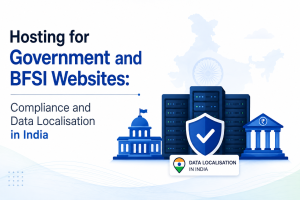
If you are building or managing a website for a government body, a bank, or any BFSI platform, hosting is not just a technical decision. It is a compliance decision. Choose the wrong provider, and you are not just risking downtime; you could be putting your organisation in breach of rules set by MeitY, the RBI, or both.
This is different from picking hosting for a regular business website, where speed and uptime are usually the only things that matter. For government and BFSI websites, where the data lives, who can access it, and who has verified that, all matter just as much.
Think of data localisation like keeping your original documents in a locker in your own city, rather than mailing them to a locker in another country and simply keeping a key to access them from here. Being able to reach the data is not the point. Where it physically sits is.
Some data is just too sensitive to run that risk. This includes financial records, health information, government identity data and citizen records. When this data is compromised, misused or accessed by unauthorised parties, the impact is not limited to inconvenience – it can affect national security, financial stability and the personal safety of citizens. By storing this data in India, it means that Indian laws, Indian courts and Indian regulators remain the ones responsible for protecting this data.
In India, data localisation means that certain categories of data generated by, or relating to, Indian citizens must be stored on servers physically located within India. It is not enough for a foreign server to be “accessible” from India. The server itself has to be on Indian soil. For government and BFSI websites, this is not a best practice. It is a legal requirement.
Most websites can run on the same hosting as any other. For a blog, a small business site, or even a mid-sized e-commerce store, the requirements are largely the same: speed, uptime, and a reasonable amount of security.
Government and BFSI websites are not like most websites. They hold data that affects citizens’ identities, savings, and legal standing, and they answer to regulators who can shut them down if the hosting behind them does not meet the mark. Specialised hosting is not an upsell for this category. It is the only category of hosting that actually fits the job.
These platforms hold identity details, addresses, account numbers, and other personal data tied to real people. A breach here does not just cost a company its reputation—it exposes citizens and customers to identity theft, fraud, and harm that follows them well beyond the incident itself.
Every payment processed carries an expectation of accuracy and traceability. A transaction that fails silently, gets duplicated, or cannot be audited later is not a minor bug. It is a direct hit to trust in the institution behind it.
Government portals contain legally sensitive records, welfare data, tax records, and legal documents. Unauthorised access or loss is not a mere technical failure but a breach of public duty.
Government and BFSI platforms are often used at a scale that few commercial websites experience, especially during the peak periods of tax filing deadlines, benefit disbursements or banking cycles. A host needs to be able to handle this sort of steady, high-volume traffic without breaking.
The very content these platforms host makes them frequent targets of cyberattacks, from phishing and data breaches to more organised efforts to take down services altogether. The stakes of a successful attack are proportionally higher than for an average business website.
None of the above is left to individual discretion. Government hosting must meet MeitY empanelment and STQC audit standards. BFSI hosting must meet RBI’s data localisation requirements. Both sit under the broader obligations of the DPDP Act. Compliance here is not a best practice; it is a legal condition of operating at all.
Taken together, these factors are exactly why generic hosting falls short for this category and why the infrastructure behind government and BFSI websites has to be built differently from the ground up.
This is exactly the gap host.co.in‘s hosting infrastructure is built to close — Indian data centres, compliance-ready architecture, and support that understands what government and BFSI platforms are actually up against.
Government and BFSI handle a lot of sensitive data: public information and strict regulatory data, which should be built on an infrastructure that is safe and secure.
When we talk about compliance, the Indian government has accumulated many compliances, like the DPDP Act, which standardises and formulates how organisations collect, store, and use public, customer, or user data, where businesses need to follow the law. Not only this, but today India believes in keeping its data within the country itself, delivering data sovereignty: data curated in India should not leave India; it should stay in India itself, which not only generates safety for people and organisational data but also prevents misuse of your data outside the country or data theft.
India has formulated many standard acts for industries toward data safety, and this compliance is very crucial to incorporate safety for your business — not just a legal requirement. When you follow compliance set by the government, you get the advantage of:
Citizens and customers use official digital touchpoints; observable compliance generates long-term trust in digital public services and banking.
Non-compliance with the DPDP Act leads to penalties in the crore range as well as operational disruption through audits, notices, and forced remediation. A compliant infrastructure eliminates this exposure before it becomes a liability.
Government and BFSI projects go through sector-specific scrutiny before going live – RBI guidelines for banks and MeitY empanelment for government platforms. Hosting that already meets data localisation and security standards and sails through these checks with far fewer objections.
When data is outside India, it is subject to the laws of another country and may be subject to that country’s agencies, courts, or breach events in ways that an Indian organisation has no control over. Keeping the data within Indian borders completely eliminates this exposure.
Compliance frameworks don’t end with data storage; they require incident response protocols, breach notification timelines, and recovery plans. An organisation structured around these requirements will respond to a security incident with an existing process, not by trying to create one on the fly.
Data localisation and compliance certification have now become must-have eligibility criteria and not preferences for government tenders and BFSI vendor empanelments. An organisation that already meets these standards is eligible for opportunities that non-compliant competitors can’t even bid for.
With policy increasingly moving towards keeping citizen and financial data in-country, early compliance means the organisation grows with regulation, rather than scrambling to catch up with each new requirement.
It is far more costly to retrofit infrastructure for compliance, migrating data, rebuilding storage architecture, and renegotiating vendor contracts than to design for compliance up front. Compliance-first infrastructure eliminates this future cost.
| Aspect | Data Stored in India | Data Stored Overseas |
| Legal jurisdiction | Under Indian Laws (DPDP Act, IT Act) | Subject to the laws of the host country |
| Government/Regulatory Access | Indian regulators and courts have direct control. | Foreign agencies or courts can access the data under their laws without India’s consent. |
| Breach accountability | Indian authorities can directly investigate and punish. | An investigation needs cooperation from a foreign jurisdiction, and that can be slow or limited. |
| Data sovereignty | Indian control is always on data. | Control shifts, at least in part, to the country where the servers are located |
| Latency and speed | The reduced physical distance helps Indian users reach faster. | The farther away, the more latency and the slower the load times. |
| Compliance alignment | Engineered from the beginning to meet Indian regulations | May need additional steps to comply with Indian requirements |
| Support and resolution | Works in Indian time zones, easier coordination | Support and issue resolution times may be affected by time zone differences. |
Government and BFSI platforms cannot run on infrastructure that only looks secure on paper. The underlying hosting needs specific technical capabilities built in from the start, each addressing a different type of risk. Here is what these platforms require and why each one matters.
As covered above, this is the foundation everything else is built on. Hosting infrastructure located within India keeps data under Indian jurisdiction and aligned with data localisation requirements from day one.
Government portals or banking platforms usually work 24/7: a citizen filling a form at midnight or a customer needing emergency money on a holiday. High uptime guarantees, typically 99.9% or above, ensure the platform stays accessible rather than going down at unpredictable moments.
No infrastructure is immune to failure; a fire, a flood, a hardware fault, or a regional outage can take a data centre offline. Disaster recovery means having a plan and a backup system ready to bring services back online quickly if the primary infrastructure fails, rather than leaving citizens or customers locked out for days.
Data handled by government agencies or banks is very crucial, and it can be lost through human error, corruption, or a cyberattack, not just through hardware failure. Automatic backups create regular, scheduled copies of data without relying on someone to remember to do it manually, so that a recent, restorable version always exists.
A Distributed Denial of Service (DDoS) attack floods a platform with fake traffic until it slows down or crashes entirely. Government and banking platforms are common targets for exactly this kind of attack, since taking them offline disrupts essential services. DDoS protection filters out this malicious traffic before it can overwhelm the system.
Not all threats will be stopped by a firewall. Intrusion detection systems constantly monitor the network for malicious activity or any actions that resemble an attack. If they detect anything suspicious, they immediately raise an alarm, allowing the issue to be addressed before it becomes uncontrollable.
Not every user of a system needs to see everything in the system. Access control is the ability to restrict access to certain data to authorised persons only, depending on their role. This reduces the damage that can be done from a single compromised account or an unwise employee.
A power outage shouldn’t mean a platform goes dark. Power systems such as backup generators and battery systems keep the servers running even if the main power supply fails.
Even organisations that take compliance seriously often get a few things wrong, usually because the rules sound simpler than they actually are in practice. Here are the mistakes that come up most often.
A server hosted overseas can still load favourably for Indian users and can still be reached through an Indian domain. None of that changes where the data physically sits. Accessibility and location are two different things, and data localisation is only satisfied by the second one.
Getting certified or meeting a regulation is not a one-time event. The DPDP Act and similar regulations are changing, audits are conducted from time to time, and infrastructure that was compliant a year ago can no longer be compliant if it is not reviewed and maintained. Compliance is a continuing responsibility, not a tick-box to tick at launch.
A well-known global hosting brand is not automatically the right choice for a government or BFSI platform. If that provider’s servers sit outside India, or if it cannot demonstrate the specific certifications a regulator asks for, the platform is non-compliant regardless of how reliable or popular that provider is elsewhere.
Some organisations plan for downtime but not for what happens after a data breach — the notification timelines, the regulatory reporting, and the public trust that has to be rebuilt. Without a response plan already in place, the aftermath of a breach often causes more damage than the breach itself.
A BFSI platform or a government portal needs more than just DPDP Act compliance. MeitY empanelment for government websites and RBI guidelines for banks are two different requirements, and simply complying with one does not mean another is also taken care of.
The DPDP Act has a wide application to any organisation, whether governmental or private, which processes the personal data of individuals in India. This includes state government platforms as well as central government platforms.
Consequences of such an act might be financial sanctions, halting of service provision until the issue is solved, and, in extreme cases, cancellation of the licence/approval required to function.
Not exactly. Data localisation refers to physically storing data within a country’s borders. Data sovereignty is the broader principle that data is subject to the laws of the country it is stored in. Localisation is one of the ways sovereignty gets enforced.
Only if that provider operates data centres physically located within India and meets the specific certifications the sector requires, such as MeitY empanelment or RBI’s localisation norms. A global brand name does not substitute for these requirements.
Regulations change, and audits recur, so compliance should be reviewed at least annually, or immediately whenever a relevant law or guideline is updated.
Hosting for government and BFSI platforms was never just about uptime or speed. It is about where the data lives, who is legally responsible for protecting it, and whether the infrastructure behind it can stand up to both cyber threats and regulatory scrutiny. Data localisation,
DPDP Act compliance and sector-specific requirements from bodies like the RBI and MeitY are not optional extras layered on top of good hosting; they are what good hosting means for this category of platform. Getting this right from the start saves an organisation from legal risk, builds lasting trust with citizens and customers, and positions it to grow alongside India’s regulatory landscape rather than constantly playing catch-up with it.
This is exactly what host.co.in‘s hosting infrastructure is built around — Indian data centres, compliance-ready architecture, and the kind of support that understands what government and BFSI platforms are actually up against.

Prathamesh Suryawanshi