Picture a business that sells home decor products online. It starts in India, does well, and decides to expand into France and Germany. The team translates every page, hires native copywriters, gets the keywords right in each language, and launches, expecting the same success it saw at home.
Six months later, the France and Germany traffic barely moves. The translations are accurate. The keywords are the right ones. Nothing about the content is wrong. What nobody checked was the hosting underneath it: the entire site was still served from a single server, thousands of kilometres from either new market, with no content delivery network and no hreflang tags telling Google which page was meant for which country. Pages took several extra seconds to load for visitors in Paris and Berlin, and Google had no clean signal for which version to show whom. The content was ready. The infrastructure was not.
This is the part of multilingual SEO most guides skip. Translation gets your message understood. Hosting infrastructure, server location, CDN setup, URL structure, and hreflang decide whether that message gets found and loads fast enough for anyone to read it in the first place.
Multilingual SEO is the practice of optimising a website so it ranks well in search results across more than one language. This is not quite the same as international SEO, which targets specific countries; multilingual SEO targets “languages”, which can span several countries at once. A Spanish-language strategy, for instance, covers Spain and much of Latin America together.
Most multilingual SEO advice stops at content: translated pages, localised keywords, and culturally adapted copy. All of that matters. But search engines also evaluate how fast a page loads and how clearly it is targeted to a region, and both of those depend on infrastructure decisions made long before a single word gets translated.
Businesses operating in India might limit themselves by staying within India itself. When you execute multilingual SEO, you are not just translating content; you are letting other corners of the world know exactly what you do. When a business expands, opening more branches will not necessarily grow it.
Expanding your service in a native language for people will let your business grow, because a person sitting in France might be more interested in your business than a person sitting in India. Providing that accessibility to your business is possible with multilingual SEO. It helps to be clear on why businesses take this on in the first place. A few reasons keep coming up:
English is quite a standardised language used internationally, so if you are expanding your business, understanding the language factor is essential. A site only in English is invisible to a huge share of the world that searches and shops in their own language first.
Besides English, Mandarin Chinese, Spanish, and French are among the major global languages with widespread international presence. Understanding the audience you are targeting and using their language will help you expand internationally.
Improve user experience. Visitors trust and understand a site more when it speaks their language natively, rather than through a browser’s auto-translation.
When you buy something in your own country and interact with a shop owner, the negotiation feels friendlier when the language is native rather than foreign. Even as a business, if you started in English, understanding the local market’s communication style is crucial.
Even if you are operating within India, going multilingual in the languages where you get more business, like South Indian or North Indian languages, will give you more opportunity. Language is not a barrier; it is a tool to get closer to your customer. A properly localised site, not just translated but adapted to local tone and context, signals that a business is genuinely present in that market, not just passing through.
Imagine your site content is in English, and you use keywords so that when a user searches, they find your website: that is one part of it. Now imagine you adapt to more languages: each language’s keywords bring in new users of their own. Many businesses invest in inorganic traffic to grow their brand visibility, but with a smarter move, you can organically reach a much wider audience by being their native communicator.
When you expand your multilingual SEO, search engines can crawl and understand it, reaching the users who need it. Each language version is a separate opportunity to rank in that language’s search results, which a single-language site simply cannot compete for.
A content delivery network solves the distance problem without needing a separate server in every country. A CDN keeps cached copies of your site’s content in data centres spread across the world, so a visitor’s request gets served from whichever location is nearest to them, rather than travelling all the way back to your main server every time.
For a multilingual site specifically, this matters more than for a single-language one, simply because the visitors are spread across more places by design. Cloud hosting plans that include CDN support let a multilingual site stay fast everywhere it is trying to rank, instead of being fast only near its original server.
Search engines can detect the language a page is actually written in by analysing the content itself, separate from any tags you add.
This acts as a baseline check: if your hreflang tag says a page is in French but the actual content is in English, that mismatch can confuse ranking rather than help it.
The lang attribute in your HTML (e.g. <html lang=”fr”>) is a direct signal that reinforces this, separate from hreflang.
Helps Google display the correct language or country-specific version of a webpage to users. Tells search engines which language and region a specific page targets and links it to the equivalent pages in other languages.
Format pairs a language code with an optional region code, e.g., ‘fr’ for French generally, or ‘fr-CA’ for French as spoken in Canada specifically.
Needs to be reciprocal; if Page A points to Page B via hreflang, Page B must point back to Page A, or the signal is considered broken.
Common mistake: adding hreflang tags without a matching, dedicated URL for each version (which is why URL structure has to be sorted first)
Google needs each language to live at its own dedicated URL, a ccTLD, a subdirectory, or a subdomain: not one page auto-translation based on browser settings.
A clear, consistent structure makes it obvious which URL belongs to which language, which is also what makes hreflang tagging accurate rather than guesswork.
Title tags and meta descriptions should be written natively in each language, not machine-translated word-for-word from the English version.
These are often a searcher’s first impressions in results, so they need to read naturally in that language, matching how people actually search, not just what a direct translation produces.
Linking between language versions of the same page (via hreflang, plus visible navigation like a language switcher) helps search engines understand the versions are connected, not duplicate or competing content.
Internal links should stay within the same language wherever possible; a French page linking to an English page confuses both the user experience and the language signal you are trying to send
Keyword research has to happen per language, not as a direct translation of your English keywords. People in different regions search differently, even when asking for the same thing, so the keywords behind each version need their own research rather than a straight translation.
Each language version needs to actually get indexed on its own, and incorrect or missing hreflang is one of the most common reasons a version fails to index the way it should, even when the content itself is fine.
A sitemap that includes all language versions, ideally with hreflang annotations built in, helps search engines discover and crawl every version rather than relying on them being found organically.
Useful for avoiding duplicate content issues, but they need to be set up carefully with multilingual sites. A canonical tag pointing one language version back to another can quietly cancel out your hreflang signal, so canonical tags should generally point a page to itself, not to a different language version.
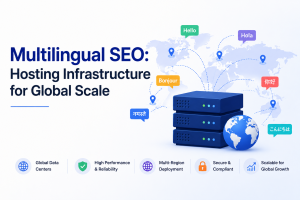
Multilingual SEO helps search engines understand which page belongs to which language and region. Hosting infrastructure is what actually delivers those pages, quickly and reliably, to whoever is searching for them, wherever they are in the world. One without the other only gets you halfway.
A page can be perfectly translated, tagged, and optimised, but if the server itself is slow to respond, none of that matters, because the visitor is still left waiting regardless. This comes down to the hardware behind it: CPU, RAM, and especially storage, and for a multilingual site handling more pages and more simultaneous visitors across time zones, there is less room to compromise on this than there is for a single-language site.
NVMe SSDs read and write data far faster than older SATA SSDs or traditional hard drives, because they connect directly to the system instead of going through a slower, older interface. That speed difference shows up directly in load time, and it applies to every page, in every language, equally.
For a multilingual site targeting several regions, downtime does not just affect one market; it takes every language version offline for every region at once. A business live across several countries has no quiet hours, since somewhere in the world, someone is always awake and searching.
A multilingual site tends to grow in a specific direction: not just more visitors, but more languages, more regional versions, and more content over time. Hosting needs to be able to grow with that, without forcing a full migration every time a new language or market gets added.
This is about how well-connected the server is to the wider internet, not just its own hardware. It matters more the further a visitor is from the server, and while a CDN helps with this, it cannot fully make up for a server with genuinely poor connectivity underneath it.
A multilingual site is often a bigger target simply by having a larger footprint: more pages, more entry points, and traffic from more regions. Every domain or subdomain in use needs its own SSL/TLS certificate, along with regular backups and protection against DDoS attacks. Trust matters even more to a visitor in an unfamiliar market, who is quicker to leave a site that does not look secure.
DNS resolution is the step where a domain name gets translated into the server’s actual address, and it happens before anything else on the page can even start loading. For a multilingual site running several ccTLDs or subdomains, that delay compounds across every domain in use, not just one.
Whichever markets you are expanding into, hosting infrastructure like this is what makes a multilingual strategy actually work in practice, not just on paper. host.co.in’s VPS and cloud hosting plans come with the regional data centre options, CDN support, high uptime, and scalability a growing multilingual site needs, so the infrastructure is ready before the first translated page even goes live.
A price changes, a policy updates, a product gets discontinued, and the English page gets updated while the French or German version quietly stays outdated for weeks. Visitors in that market end up acting on wrong information, and trust takes the hit, not rankings.
A page can rank well in a new market, bring in traffic, and still fail, because there is no one on the other end who can answer a query in that language. Support, sales follow-up, and even a contact form that only accepts English input can quietly undo everything the SEO work achieved.
A business new to France or Germany is not just competing on keywords; it is competing against businesses that have been native to that market for years, with an intuitive sense of tone, pricing expectations, and buying habits that a translated site cannot fake overnight.
A lot of businesses budget for the translation and the initial setup, then are caught off guard by the ongoing cost of keeping every language version updated, tested, and supported, month after month, as the business itself keeps changing.
Going multilingual in five languages sounds ambitious, but if two of those markets never generate meaningful traffic or business, that is ongoing hosting, translation, and maintenance costs being spent somewhere it is not paying back. Most businesses find this out only after launching everywhere at once, rather than starting focused and expanding based on real demand.
Set up a process (even a simple checklist) so that when a price, policy, or product changes in one language, the update is tracked across every other version too, instead of relying on someone remembering to translate it later.
Make sure someone can actually respond to a lead, support query, or contact form in that language before pushing hard to rank there. Traffic without the ability to convert it is wasted spend.
Pick the first new language based on where you already have some insight into pricing, tone, or customer behaviour, rather than the market with the highest search volume on paper.
Treat translation, hreflang maintenance, and content updates as a recurring line item from day one, the same way you would budget for hosting or support staff, not a one-time project cost.
Launch in one or two languages first, watch which ones actually convert, and expand further only once a market proves it is worth the ongoing investment, rather than going multilingual everywhere at once.
Yes, page load speed is important for visitors in different regions; the location of the server affects your page speed and search engine ranking. A slow page can cause low user retention. Thus, if the server is far from a target market, it generally leads to slower load times there.
Not strictly required, but it helps a lot. A CDN will serve content from the nearest location to each visitor, helping to keep load times consistent in every region a multilingual site is trying to reach.
Either works, along with a ccTLD. The important thing is that each language has its own unique URL, rather than a single page that dynamically translates itself, so search engines can index each version independently.
No. Translated content still needs proper infrastructure and technical signals — hreflang tags, a clear URL structure, and hosting fast enough for each region, or search engines have no reliable way to know which version to show whom.
That will depend on the market and competition, but it will usually be along the same lines as regular SEO – often several months before you see any real ranking movement and sometimes longer in more competitive languages or regions.
Multilingual SEO targets a language, which can cover multiple countries – Spanish, for example, covers Spain and much of Latin America. International SEO targets countries individually, even if they are speaking the same language.
Translation gets a multilingual site understood. Hosting infrastructure, server location, CDN, URL structure, and hreflang get it found and loading fast enough for anyone to stay and read it. Getting the content right without checking the infrastructure underneath is how a well-translated site ends up going nowhere, the way the home decor business in the example above did before fixing what was actually holding it back.
Whichever markets your site is expanding into, host.co.in’s cloud hosting and VPS hosting plans support the regional data centres and CDN setup. A multilingual site needs to actually perform where it is trying to rank

Prathamesh Suryawanshi