The VPS vs Cloud hosting debate comes up for almost every website owner at some point, usually at exactly the moment when shared hosting feels less adequate and the options suddenly multiply. Both are genuinely capable hosting solutions, and both will serve most websites well, but they are built on different principles, and they suit different situations in ways that are worth understanding before you make a decision you will live with for a year or more.
The VPS vs cloud difference is not always explained clearly in the places people look for answers. Most comparisons either oversimplify to the point of being useless or go so technical that the average website owner ends up more confused than when they started. This guide cuts through that and gives you a practical, honest answer based on what your website actually needs.
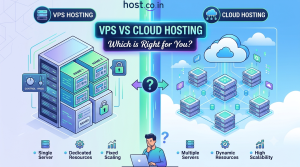
A VPS, or Virtual Private Server, takes a physical server and divides it into multiple isolated virtual environments using virtualisation technology. Each virtual environment gets its own set of dedicated resources like CPU, RAM, bandwidth, and storage so it doesn’t have to share them with other users. What happens in one VPS has no effect on another running on the same physical machine.
Think of it like a block of flats. The building is shared, but your flat has its own walls and its own front door, and your neighbours cannot wander in uninvited. The resources in your environment are yours and predictable.
VPS hosting gives you more control than shared hosting because you typically get root access to configure the server environment, install the software you need, and manage security settings the way your application requires. Since the resources are fixed, you’ll know what you pay every month. Thus, there are no surprises in billing, and the performance stays reliable.
host.co.in’s VPS Hosting India is built on 4th generation AMD EPYC processors, DDR5 RAM, and 100% NVMe SSD storage for high-speed, reliable performance. Plans also include a 1 Gbps network speed and full root access, with Indian data centers. Which is beneficial for assuring lower latency for Indian audiences.
Cloud hosting distributes your website across multiple servers in a network rather than tying it to a single physical machine. If there is a sudden spike in visitors the system simply distributes the traffic across multiple servers. In cloud hosting the resources scale automatically to keep running your website efficiently.
Cloud hosting is like living in a city where you are not stuck with only one apartment. But you can use rooms from different buildings whenever required.
The defining characteristic of cloud hosting is elasticity. Resources can be added or reduced quickly in response to actual demand rather than being fixed at a provisioned level. For websites where traffic is genuinely unpredictable, this flexibility is valuable. For websites where traffic is steady and predictable, the flexibility comes at a cost that may not be justified.
host.co.in’s Cloud hosting India plan is designed to handle growing websites smoothly. That means the hosting setup scales automatically as your website traffic increases, but the performance remains stable.
This is the question that actually matters, and the answer depends more on your website’s behaviour than on which technology sounds more impressive.
You want your hosting cost to stay the same every month. As said earlier, VPS plans come with fixed pricing depending on the resources you have provisioned. There are no surprise bills at the end of the month because a traffic event consumed more than you budgeted for. What you see on the pricing page is what you pay.
Your traffic is steady and manageable. If your website receives consistent traffic without dramatic peaks and troughs, a well-sized VPS handles it reliably without paying for elastic capacity you never actually use.
You need more control over server settings. Root access on a VPS lets you configure the environment precisely. The PHP version, the web server software, the database settings, and the security configuration, all of these are yours to manage.
A VPS lets your application run the way it’s supposed to, without unnecessary restrictions.
You can host a business website, portfolio, or medium-sized application with continuing demands. This kind of setup works well on a reliable VPS hosting because you get stable resources and predictable pricing without added complexity.
Your traffic changes often. A website that receives ten times its normal traffic during a sale, a product launch, or a media mention needs infrastructure that scales with that spike rather than going offline under the pressure. Cloud hosting handles this naturally.
You expect business growth or seasonal spikes. If your business is growing and you cannot accurately predict where your traffic will be in six months, cloud hosting means you are never underprovisioned. Resources scale as your needs grow without requiring a manual plan upgrade or a server migration.
Uptime and flexibility matter more than fixed costs. Cloud infrastructure is generally more reliable because it runs across a number of servers.
If you run eCommerce stores, SaaS products, or growing websites, cloud hosting is better because their traffic can go up and down unexpectedly.
Choosing the right hosting isn’t about going for the ‘advanced’ option, but it’s about what fits your needs. It is about matching the infrastructure to what your website actually needs right now while having room to grow when requirements change.
If your website has stable, predictable traffic and you want dedicated resources, full control, and a fixed monthly cost you can budget around, host.co.in’s VPS hosting delivers the performance and reliability you need.
The infrastructure runs on current-generation AMD EPYC hardware with NVMe SSD storage and a 1 Gbps network speed, hosted in Indian data centers with 99.95% uptime. You get root access on every plan and 24/7 support through live chat, phone, and tickets.
If your website is growing, your traffic fluctuates seasonally, or you need the resilience that comes from distributed infrastructure, host.co.in’s cheap cloud hosting plan gives you the scalability and high-availability environment that variable-demand websites benefit from. The managed cloud setup means the infrastructure scales with your needs without requiring you to be a server administrator to keep it running properly.
Neither option is universally better. The useful question is which one aligns with how your website actually behaves and how your business is likely to grow over the next year or two. host.co.in gives you both options under one roof, which means you are not starting over with a different provider when your needs evolve.
The VPS vs Cloud hosting choice is genuinely not complicated once you understand what each one is built for. VPS hosting is the right answer when you want dedicated resources, predictable costs, and control over your server environment. Cloud hosting is the right answer when your traffic varies, your business is growing, or uptime and automatic scaling matter more than a fixed monthly bill.
Most businesses begin with VPS hosting and upgrade to cloud hosting or Cloud VPS hosting when they need greater scalability and flexibility. Some businesses know from day one that they need cloud flexibility. Both paths are valid, and the infrastructure decision should follow the business requirement rather than the other way around.
Explore host.co.in’s VPS and Cloud hosting plans and find the option that fits how your website actually runs.

Madhavi Potdar