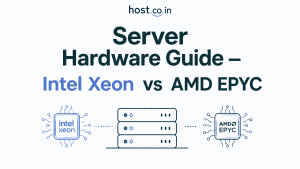
If you have been comparing AMD EPYC vs Intel Xeon, chances are you have already opened ten browser tabs and, somehow, ended up more confused than when you started.
One article talks about core counts. Another dives deep into benchmarks. Someone else says AMD is the future, while another insists Intel is still the safer bet.
In reality, the best server processor is not necessarily the one with the highest specs, but it depends on what you are actually trying to run.
A hosting company running hundreds of virtual machines will not choose hardware the same way an eCommerce business or ERP setup would. That is why an Intel Xeon vs AMD EPYC comparison becomes far more useful when you stop looking only at specs and start looking at workloads.
This guide breaks things down in plain English so you can figure out what genuinely makes sense for your server.
Before getting into the AMD EPYC vs Intel Xeon Scalable debate, it helps to understand what actually impacts server performance.
Because honestly, most people end up focusing on the wrong things.
Think of cores as workers handling tasks.
More cores generally help when many things are happening at the same time. For this reason, workloads like virtualization, cloud VPS hosting, and databases find it useful for handling multiple tasks at the same time.
It’s about how fast the task is done.
Some workloads care more about speed per core than total core count. Certain enterprise applications and databases fall into this category.
It is deemed crucial since servers need adequate RAM to perform smoothly. So when more than one user is browsing your website at the same time or your application needs to handle a significant volume of data, it becomes more important.
Without going into the technical details, PCIe lanes define how much room your server has for high-speed storage, networking devices or GPUs.
This becomes especially important for AI, storage-heavy applications, and virtualization.
If you do not want to spend hours comparing technical sheets, here is the short version.
|
If You Care More About… |
AMD EPYC |
Intel Xeon |
|
Higher core counts |
Strong choice | Good |
|
Price-to-performance |
Usually better | Decent |
|
Enterprise software compatibility |
Good |
Often preferred |
|
Virtualization |
Excellent |
Very capable |
|
Single-core workloads |
Strong |
Often performs well |
|
AI and GPU-heavy environments |
Strong |
Good |
Here is the honest answer most comparison blogs skip.
Neither is automatically “better”.
The real winner depends on what your server is expected to handle day after day.
If there is one thing people often compare in the Intel Xeon vs AMD EPYC discussion, it is core count. AMD EPYC processors often come with more cores, which is one reason they work well for multitasking workloads. Thus, it results in better resource handling.
This is where things become more balanced.
Not every application needs a large number of cores to perform seamlessly. Some simply work better when each task can run faster.
Certain enterprise applications, ERP systems, and legacy software can benefit from Intel’s architecture.
So even when AMD often outperforms in EPYC vs Xeon benchmark tests, Intel still remains a solid choice for activities that rely on single-core performance.
Power costs add up faster than most businesses expect.
AMD EPYC processors are generally known for offering better performance-per-watt, which can matter if you are running servers long-term or operating at scale.
For businesses planning infrastructure growth, efficiency becomes an underrated advantage.
This is the part people rarely think about until something breaks.
Some enterprise software ecosystems have traditionally been more Intel-friendly. If your business depends upon specific business software, make sure it performs smoothly with the processor you are thinking of choosing.
This does not mean AMD struggles here. It simply means Intel still feels more familiar in some traditional enterprise environments.
This is the part that actually matters. Forget technical debates for a minute. Let’s talk about real-world use cases.
AMD EPYC usually makes more sense.
When a server is expected to handle a number of virtual machines simultaneously, AMD EPYC often performs really well. That is why many hosting providers have started choosing AMD EPYC-powered servers.
If your goal is maximising resources across multiple workloads, AMD often comes out ahead.
This depends on traffic size.
If you are running a relatively small online store, either of them will likely to do the job properly. But if your eCommerce store handles heavy traffic and constant database activity, AMD EPYC often comes as a valuable option.
That said, hosting setup matters just as much here.
A poorly configured powerful processor can still underperform.
Intel Xeon often remains a strong option.
If your business runs older or enterprise-focused software, you might have long been associated with the intel systems. That familiarity is one reason Xeon still feels reliable in more traditional setups.
If your priority is reliability and smoother compatibility with the software, then Intel Xeon is again a strong option to consider.
AMD EPYC has gained a lot of momentum here.
Its PCIe lane advantage often helps when handling GPU-heavy environments, which matters for AI workloads.
If your infrastructure relies heavily on GPUs, AMD usually feels more flexible.
This is where the AMD EPYC vs Intel Xeon conversation gets interesting.
Many Web hosting providers increasingly prefer EPYC because of virtualization efficiency and stronger core density. When a server has more cores to work with, it often means you can efficiently manage multiple websites or workloads at once.
Benchmarks are useful.
But they can also be misleading.
A processor showing 15% higher performance in testing does not automatically mean your website or application will suddenly become dramatically faster.
Storage matters.
RAM matters.
Network setup matters.
Server optimisation matters.
The reality is this:
A well-configured server with the right workload fit usually performs better than expensive hardware chosen only because benchmark numbers looked impressive.
That is why chasing the highest EPYC vs Xeon benchmark score is not always the smartest move.
The better question is:
Which processor fits what I actually need?
A lot of businesses overspend or underbuy because of avoidable mistakes.
More is not always better.
Some workloads simply do not need dozens of cores.
The processor might be excellent, but if your software prefers one ecosystem, that matters.
Think six to twelve months ahead.
Will your traffic grow? Will workloads increase?
Choosing slightly smarter today can save migration headaches later.
A fast processor paired with weak storage or poor RAM allocation still creates bottlenecks.
The processor is important, but it is not the only thing that affects performance.
The better way to answer this question is:
There is no universal winner.
If virtualization, cloud hosting, performance-per-value, or scalability matter most, AMD EPYC often feels like the stronger choice.
If enterprise compatibility, familiar ecosystems, or specific workloads matter more, Intel Xeon still remains incredibly capable.
The smarter decision is not asking:
Which processor is better?
Instead, ask:
Which processor makes sense for what I am trying to run?
That question usually leads to a much better answer.
The AMD EPYC vs Intel Xeon debate is not going away anytime soon, and honestly, that is probably a good thing. Competition keeps server hardware improving.
But if there is one thing worth remembering, it is this:
Specs alone do not decide the winner. Your workload does.
No matter what you are running, a business software, hosting setup, or heavier workloads, the things simply work better when your server setup matches what you actually need.
That is where host.co.in makes the process simpler. Instead of forcing one-size-fits-all setups, you get hosting solutions designed around performance, scalability, and the kind of workloads businesses actually run.
If business growth is pushing you towards a Dedicated server upgrade, host.co.in is worth exploring.

Madhavi Potdar