If you want to give something to someone, you do not speak to the delivery man and say, “Give this to my friend.” Instead, you just give him an address so he knows exactly where to deliver it. An IP address is the same; it’s the address that helps a request find its way to a website.
You might create a domain name for your website and set up DNS, but how do computers actually find your website’s address? Through its IP address. Computers don’t understand human language like xyz.com; DNS translates the domain name into a numeric address.
If you are seeking to know the difference between IPv4 and IPv6. IPv4 is the standard that has long determined IP addresses for websites. But is IPv6 simply a faster version of IPv4, or is it something entirely different? In this article, we dive into exactly what sets the two apart and how a business owner should choose between them.
An IPv4 address is a standardised type of address protocol on the internet. It provides the format and rules regarding how an IP address should be written.
Simply put, it is the address protocol that all devices on the internet have in order for other devices to know where to send their information.
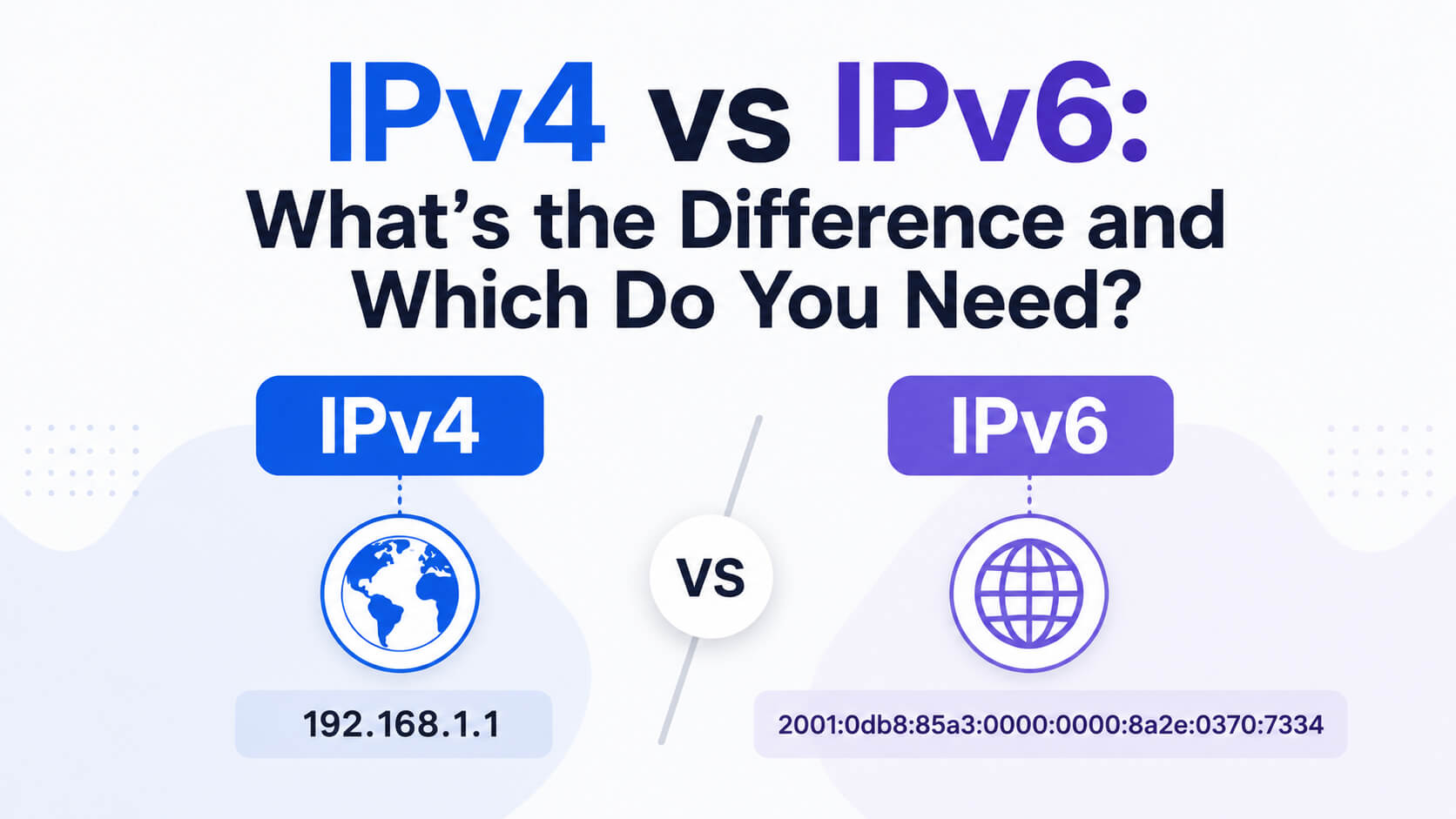
It has the format of numbers separated by dots, such as 192.0.2.1. This is the original address protocol for the internet.
Although IPv4 has been the standard protocol, today it comes with a limitation. Imagine when you registered for a phone number earlier, the number format usually went with a certain range, and no one imagined the number of phones needed would grow the way it has, with a phone becoming a daily need for almost everyone. In the same way, IPv4 could handle billions of new IP addresses, but that was a long time ago. Now it is no longer sufficient, since almost every home has digital devices today, and each one needs its own IP address.
IPv6 is the next-generation IP addressing system; that’s because it uses a much larger address format. with its own specific standard protocol for IP addresses. An IPv6 address is not faster; it is a version that has been updated to create far more unique IP addresses. It ensures more devices can communicate using modern internet infrastructure.
On paper, IPv4 and IPv6 look like two versions of the same thing. In practice, the differences show up in how fast a packet moves, how many devices can get an address, and how much strain a network is under. Here is what that actually looks like, side by side:
| Factor | IPv4 | IPv6 |
| Format | Four groups of numbers separated by dots (32-bit) | Longer format, made up of numbers and letters (128-bit) |
| Example | 192.0.2.1 | 2001:db8::1 |
| Total addresses | About 4.3 billion available | A number so large it is practically limitless |
| Why it exists | The original addressing system | Created to solve IPv4 running out of addresses |
| Header | Can be 20 to 60 bytes, depending on what’s included | Always exactly 40 bytes, no matter what |
| Packet | Extra header checking at every router slows it down slightly | No checksum to check, so it moves through routers faster |
| Speed | Not faster on its own | Not faster on its own—just more addresses available |
Search “is IPv6 faster than IPv4”, and the real answer is not really about the protocol at all: it depends on the network it is running on. IPv6 does have some advantages built in: a header that is always the same size and no checksum step slowing down each router. On paper, that should make it faster.
But that speed only shows up if the whole path supports IPv6 properly: your internet provider, the routers in between, and the server on the other end. Many networks still run IPv6 on top of older IPv4 systems, and that extra step can cancel out any speed advantage. On networks that support IPv6 well, it can be faster. On networks where support is weak, IPv4 often does just as well, or better.
So the honest answer is: IPv6 can be faster, but only if the network underneath it is actually built for it.
At host.co.in, dual-stack support is available on VPS and dedicated hosting plans, so a site does not have to pick a side either – it’s ready for both IPv4 and IPv6 visitors
The difference between IPv4 and IPv6 is not just the address; it’s also in your DNS settings. When someone visits your domain, DNS needs to direct them to the correct address, and which record it uses depends on which version of the address you are using.
An A record directs your domain to an IPv4 address in the shorter notation. An AAAA record does the same job but points to an IPv6 address instead in the longer format. Both records exist for the same reason: to tell a visitor’s device where your server is; the only difference is what type of address they point to.
Most domains today keep both an A record and an AAAA record set up at the same time, so it does not matter whether a visitor’s device is running on DNS IPv4 vs IPv6; either way, they reach your site without any issue. If your hosting supports an IPv6 DNS server, this usually just means adding an AAAA record alongside your existing A record, not replacing it.
For a fuller breakdown of A, AAAA, and the other record types, you can check out our DNS Record Types Explained article.
Not directly. A device that only runs IPv4 cannot talk to a device that only runs IPv6 without something in between to translate. This is why most networks run both at once, known as dual stack, so nothing has to translate at all — each device simply uses whichever version it supports.
Because too much of the internet still runs on it. Routers, internet providers, and older devices are all built around IPv4, and switching everything over at once is not realistic. Dual stack is the practical middle ground while that shift slowly continues in the background.
You can check this through free online tools that show your current IP address and tell you which version it is. Most connections today support both, and your device automatically uses whichever one the network offers, without you needing to choose.
Neither of these works fast individually. Some benefits that come with using IPv6 include the fact that the protocol has a fixed-size header and does not require a checksum at each hop; however, all of these depend on whether the whole route in the network can handle IPv6. In the latter case, IPv6 is faster; otherwise, IPv4 will do just fine.
IPv6 was built with IPSec support included in the standard from the start. IPv4 can use IPSec too, but only if it is added separately. Having it built in does not automatically make a connection secure, though, since it still needs to be set up and configured either way properly.
When people talk about IPv4 vs IPv6, you should know that they are not really competing versions: one is running out of room; the other was built to fix that. IPv4 still works and still runs most of the internet, but it’s limited. IPv6 solves that limit with more addresses and a simpler header, though it only shows its real advantage when the network around it actually supports it. Most sites today don’t have to choose either way, since dual stack lets both run side by side, and that’s likely to stay the practical answer for a while yet.

Prathamesh Suryawanshi