Search PHP vs JavaScript, and you will find people arguing as if the two were fighting for the same job. They are both different languages built for different roles working toward the same goal: PHP runs on the server side, which handles the backend, while JavaScript runs on the browser to provide real-time features for website functionality. Comparing PHP vs JavaScript is like comparing tea vs coffee.
The real question most readers are trying to answer is not which language is objectively better. It is which language is right for the project sitting in front of them. This article walks through the practical differences between PHP and JavaScript, where each one performs well, and how the choice affects the kind of hosting your site will need.
PHP is a server-side programming language, which means it runs on the server and finishes its work before the page ever reaches the browser. When you search for something on your website, it works as a backend, and PHP fetches data without the user knowing. For example, if you are running an e-commerce platform, when a user visits your website and clicks on a product, PHP fetches data to check stock availability, processes the payment, and manages everything else.
So it’s a safe choice for dynamic pages, database connections, and session/auth handling. It also powers WordPress and large parts of the web. To run PHP correctly, you need the right kind of server setup, typically Linux, Apache, MySQL, and PHP together. A LAMP stack. If you are using hosting built specifically for PHP, this will already be set up for you, which avoids a lot of early troubleshooting.
JavaScript works with a browser; it works inside the browser, making your web page interactive with dropdown menus, form validation, animations, and anything that needs to respond to a user without reloading the page. The arrival of Node.js changed that. JavaScript can now run on the server too, which means the same language can build both halves of a website.
Taking the same e-commerce example: when a user visits your website, JavaScript makes sure it stays interactive and smooth to use, for instance, through scrolling buttons, toggles, or even AI-powered adaptations. Common uses today include interactive interfaces; real-time features like live chat or notifications; animations; and single-page applications, all processed by JavaScript.
JavaScript vs PHP often comes up here, because once Node.js entered the picture, JavaScript stopped being purely a browser tool and started overlapping with PHP’s job.
| Aspect | PHP | JavaScript |
| Where it runs | On the server, before the page loads | In the browser, plus on the server if using Node.js |
| What it’s mainly used for | Backend work, fetching data, handling logins | Making the page interactive: backend work too, with Node.js |
| Learning difficulty | Easier to pick up as a beginner | It takes longer, especially once you get into async code |
| Hosting it needs | A PHP-ready server (Apache or Nginx with PHP) | A Node.js server, or simple static hosting |
| Common frameworks | Laravel, Symfony, CodeIgniter | React, Vue, Angular, Express |
Node.js has made JavaScript a genuine backend contender rather than just a front-end tool. It often excels at handling many simultaneous connections, such as chat apps and live notifications. The choice between it and a traditional PHP backend usually comes down to what the site actually needs to do.
Even though PHP backends are not built for desktop applications or web games, they still work well for CMS-driven websites such as WordPress and for projects that need easier deployment since PHP handles all of that reliably. Node.js backends, on the other hand, suit projects that need real-time features such as chats and live notifications, or where the same language should run across the entire stack, especially with a high volume of simultaneous connections.
Neither is a universal answer. The right one depends on what the application is doing, not which language is trending.
Most production websites do not pick one language and exclude the other. A large share of real sites run a PHP backend alongside a JavaScript front-end, each handling the part it is best suited for.
This is also where some of the confusion around “PHP vs React” or “PHP vs Vue” comes from. React and Vue are not alternatives to PHP; they are front-end frameworks. Vue is a JavaScript framework that makes front-end development more efficient, while PHP operates on the backend. Comparing them directly is like comparing two different layers of the same website rather than two competing options for the same job.
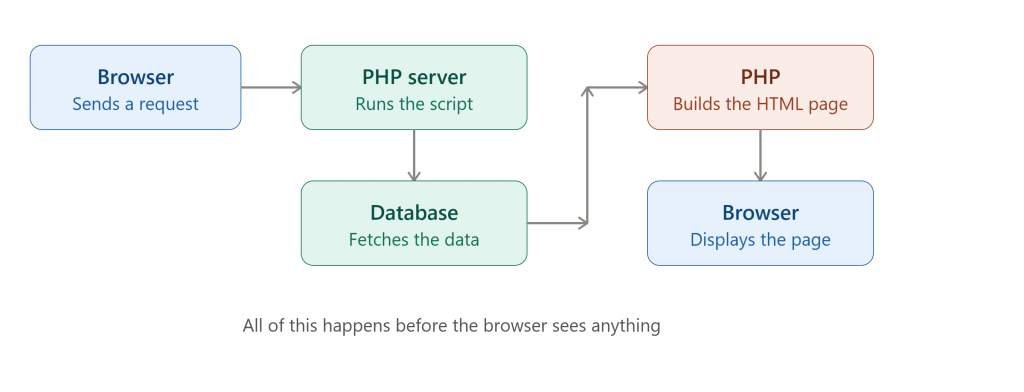
PHP is designed specifically for server-side web development. When a user generates a request to your website, PHP runs the script; builds the HTML page; and fetches the necessary data – this might be stock, customer database, or payment data – and, after processing it, directly displays it to the user.
Previously, PHP used to repeat the same process from scratch with every single request. With newer updates, PHP now uses OpCache, which saves the already-compiled code in memory so it does not have to redo that work every time. On top of that, the JIT compiler speeds up the parts of the code that run most often. Together, these make PHP a faster and more reliable backend technology.
It is easier to learn PHP because it gives results quickly, even for a novice programmer. The syntax sits right inside the HTML, so you can get something working within a few lines without any prior programming experience. However, PHP lacks the real-time interactivity that only JavaScript can provide.
JavaScript takes longer to feel comfortable with. Ideas like async/await, callbacks, and closures take real time to click, so there is more to learn before you feel confident. But it is built for interactivity from the ground up, and once you know it well, moving from browser-side work to backend work with Node.js is not a big jump.
JavaScript Toward Backend Development
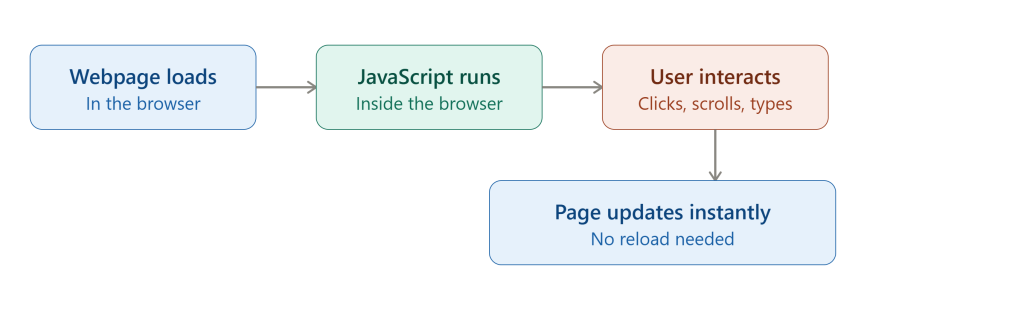
After the request is processed and the webpage is loaded in the browser, JavaScript runs inside the browser, letting the user interact through clicking, scrolling, toggling buttons, and more to make the experience feel interactive and update the page instantly. Websites used to be static; when you clicked a button, submitted a form, or added a product to a cart, the browser often had to reload the entire page each time the user interacted with it. But with the adaptation of technology, JavaScript changed this by allowing code to run directly inside the user’s browser. JavaScript performs well in user interaction, making interactive dashboards and improving user experience.
As JavaScript previously worked inside the browser itself, later Node.js was introduced, allowing it to run on the server side as well, which made JavaScript a fast execution and programming model for backend development too.
Performance depends more on hosting and server configuration, along with code quality, than on the language choice alone. A well-written PHP or JavaScript application can still run slowly on the wrong hosting setup, just as a simple one can run fast on the right plan. This is why choosing between shared hosting, a VPS hosting, or cloud hosting matters just as much as choosing between PHP and JavaScript; the language decides how the code works, but the hosting decides how well it performs under real traffic.
Both languages sit behind some of the biggest names on the internet, which says more about the strength of the pairing than the weakness of either one.
By now the differences are clear — the real question is which one fits what you are building. Here is a simple way to decide:
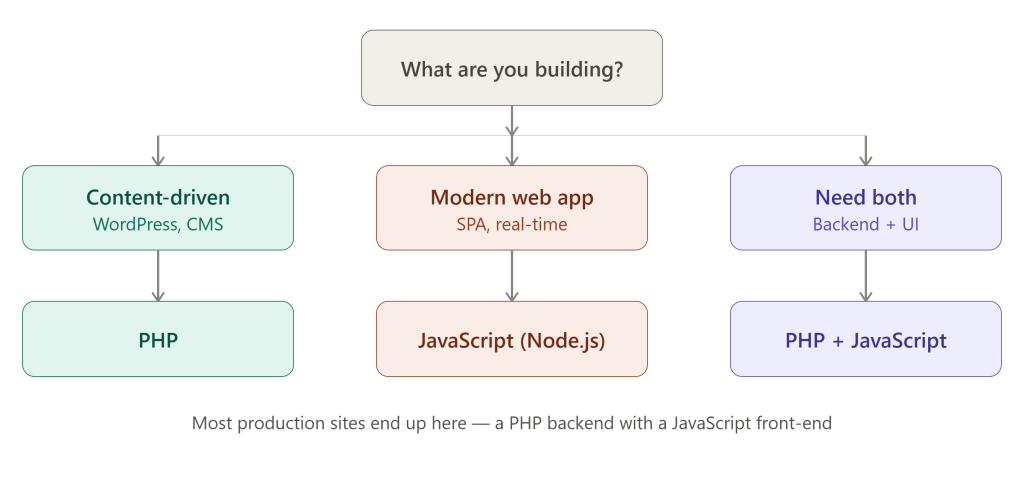
Most websites do not need to pick a side between PHP and JavaScript — the right choice comes down to what you are actually building. A content-driven site, like a blog, CMS, or WordPress build, fits PHP well since it is designed around fetching and displaying content.
A modern web app that needs real-time updates or an app-like feel is better suited to JavaScript with Node.js, since that is territory PHP was never built for. Many projects need both – PHP handling the backend logic and JavaScript handling the interactive parts users see and click on – and that combination is where most production sites genuinely end up since a content-heavy site can still want live interactivity and an interactive app still needs a backend somewhere.
The difference between PHP and JavaScript comes down to where each one runs. PHP runs on the server and finishes its work before the page reaches the browser. JavaScript runs inside the browser to make the page interactive, and through Node.js, it can also run on the server, which is really what people mean when they search JavaScript vs PHP.
PHP is easier than JavaScript. The syntax is quite simple, and you don’t have to do much work with PHP because it is right there in HTML. It takes time to learn JavaScript because of its callbacks and asynchronous/await features, but in terms of coverage, it beats PHP by miles.
Yes, through Node.js. It all depends on the type of application, but in most cases, Node.js is well-suited to highly concurrent applications like chat or notifications, while PHP is well-suited to content-heavy websites.
Modern PHP is fast. Especially with OpCache and JIT speeding up repeated code. Node.js also makes JavaScript suitable for handling concurrent connections. In practice, the speed of the language is less important than hosting and quality of code.
That depends on your backend. A PHP site needs a PHP-compatible server setup. A Node.js app needs hosting built for Node.js. If your project uses both, look for hosting flexible enough to support either.
Most modern sites are not really choosing between PHP and JavaScript; they are running both, each doing the part it does best. PHP handles the backend, JavaScript brings the interactivity, and together they cover what a single language usually cannot.
Whichever combination your project needs, Host.co.in’s hosting plans are built to support both PHP and Node.js environments, so this choice does not have to limit what you build next.

Prathamesh Suryawanshi