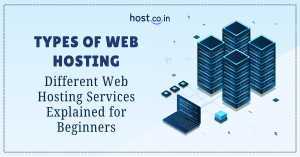
Different types of web hosting solutions are available in the market. That could make it hard for a beginner or someone who isn’t very tech-savvy to choose the right hosting option. Especially if you are new to building a website, understanding web hosting can feel somewhat challenging. Simply put, web hosting makes your website available on the internet so people can interact with it.
Also, the different types of web hosting services are specially designed for different purposes, budgets, and levels of website traffic. Some types of web hosting services are perfectly fine for small blogs or personal websites, while some are developed for handling growing businesses and high-traffic websites. So, when you know your hosting needs, it helps to avoid spending money on unnecessary features or ending up with a plan that outgrows you too fast.
In this blog, we’ll explain different types of web hosting in simple terms and show you how each differs from one another. Thus, by the time you finish reading the blog, you’ll clearly understand what web hosting is, what the different types of web hosting are, and which hosting option is perfect for your needs.
Don’t worry if you’re new to this; we’ll start by
Web hosting is a service that allows you to store and manage your website files and data on a powerful computer, commonly known as a “Server”. It keeps your website online. So, your website can be accessed anytime when someone types in your domain name.
The web hosting services are provided by the web hosts. They are responsible for maintaining the server hardware. They make sure that your website remains online by providing a reliable network connection. The hosting providers also offer the required infrastructure for your websites so that people around the world can access them.
In short, web hosting is what allows individuals, businesses, or organisations to publish their websites and make them available on the web.
This section covers how your website content is stored, managed, and delivered so visitors can access it without any trouble.
In the context of web hosting, resources are the core components like CPU, RAM, storage space, and bandwidth and other crucial features such as email, databases, security measures, and so on. It helps to power your website and determine its speed, efficiency, and reliability. The web hosting plan you select allocates certain quantities of these, and if you exceed them, it can slow down your website or take your website offline, especially during traffic spikes.
These resources are allocated by web hosting providers. In a shared hosting environment these resources are shared, while in VPS and dedicated hosting you get access to more dedicated resources.
When your website starts to grow, or when the storage runs out, or your website feels slower than before, users start to move to a higher-level plan. Because upgrading to a higher plan helps to provide better speed, more stability, and flexibility to grow.
In a managed hosting environment, the web hosting company takes care of all the technical details of running the server, such as installing new software, fixing security holes, backing up data, and providing support and monitoring around the clock. This makes things easier for the owner of the website.
In unmanaged hosting, the web hosting provider provides you with a VPS or dedicated server with complete root access, but most of the responsibility of managing it is on you. It includes managing software, OS installation, updates, security, data backups, and everything else.
Below we’ve compared the managed and unmanaged web hosting types based on the key factors. Which will help you decide what works best for you.
| Main Features | Managed Hosting | Unmanaged Hosting |
| Regular server maintenance and updates | The hosting provider takes care of server maintenance, updates, and all the technical work for you. | You are responsible for the updates and maintenance, so you need solid technical skills to keep things running smoothly. |
| Price breakdown | You are required to pay more because support and maintenance are included. | It’s usually cheaper since you’re mostly paying for the basics and not for the extra help. |
| Technical skills needed | You don’t need any technical know-how. Because the web host does the heavy lifting. | You need strong technical skills to set up, manage, and maintain the server. |
| Technical support | You get 24/7 customer support for problem-solving and assistance. | Support is limited or missing. If something breaks, it’s on you to fix it. |
| Performance & scalability | The provider offers built-in options to scale and optimise performance. Also, how well you manage things affects how well you do. | You get more freedom to customise your server, but it’s up to you to keep it running efficiently. |
WordPress hosting is built specifically for websites that run on WordPress. You receive WordPress already installed, along with built-in caching, security, and help from WordPress experts
There are numerous types of WordPress hosting, and each one is made with a certain set of needs, budgets, and skill levels in mind. It’s easy to pick the best WordPress setup for your website if you know what your needs are.
Reseller hosting is a white-labelled business model where you, i.e., a reseller, buy large amounts of web hosting resources at a wholesale rate from a parent web hosting company and then resell them to your own clients under your own brand name in order to earn profit. To start your own reseller hosting business, you are not required to pay any upfront cost and have your own hosting infrastructure.
Furthermore, the parent web hosting company takes care of server monitoring and maintenance.
Colocation hosting lets a business buy its own server hardware and rent space in a data center owned by someone else to store it. With these businesses can use professional infrastructure, such as safe buildings, reliable power, cooling, and fast internet, while still owning and controlling their own hardware and software.
Colocation Hosting Features
eCommerce hosting is a type of web hosting designed for online stores. It gives your store a secure place on a server so customers can visit, browse, and shop online. It also includes the essential tools and features online sellers need to run their store smoothly. It lets your clients visit your internet store. The eCommerce hosting company has all the capabilities that online retailers need.
Distinctive features
In email hosting, you’re provided with dedicated servers and secure infrastructure to send, receive, and store emails. It allows businesses and individuals to use custom-made email addresses such as yourname@yourcompanyname.com instead of using traditional addresses like yourname@gmail.com. It helps them look more professional and helps in branding and keeping their emails safe with the help of features such as spam filters, more storage, and 24/7 support.
The right time to move to separate email hosting is when email plays an important role in your business communication. When your existing hosting can’t keep up with email limits, regular downtimes, or email delivery issues, dedicated email hosting solutions could make a difference by providing more reliability and seamless communication.
You may need more email accounts, stronger spam filters, and tighter security when your business starts to grow. That’s where email hosting comes in. If you depend on email for things like customer service or official communication, or if you just want your email to keep running smoothly, even when your website crashes or traffic spikes, email hosting really makes a difference.
The right type of web hosting that fits your needs depends on your existing needs and where you want your business to go in the future. Small websites can get by with a simple web hosting plan, but businesses that are growing often need more power, more authority, and more flexibility to handle more traffic.
All that matters is to choose a type of web hosting that works within your budget, delivers solid performance, and handles traffic needs without making things complicated.
| Hosting Type | Price Range | Performance | Security | Ease of use | Scalability | Best for |
| Shared
Hosting |
Affordable | Suitable for low-traffic websites | Security is provided | Very easy to manage | Limited | Personal websites, blogs & small business sites |
| VPS
Hosting |
Moderately priced | More stable & reliable | Better isolation & control | Requires some technical understanding | Highly scalable | Growing businesses, developers & websites with steady traffic |
| Cloud
Hosting |
Pay-as-you-go pricing | Consistent performance even during traffic surges | Strong security | User-friendly dashboards | Highly scalable without downtime | Websites with unpredictable traffic & businesses that need high uptime |
| Dedicated Hosting | Expensive cost | Top-level performance | Maximum security | Requires technical expertise | Powerful scaling that requires hardware upgrades | Large businesses, high-traffic websites & complex applications |
| WordPress Hosting | Affordable to mid-range | Optimised specially for WordPress websites | Comes with WordPress-specific security features | Extremely easy, especially for non-tech-savvy users | Good for growing websites | Bloggers, content creators & WordPress-based businesses |
| Reseller Hosting | Moderately priced | Good & reliable for hosting multiple SMB websites | The hosting provider handles the basic security | Easy to manage due to user-friendly control panels | Flexible enough to add more customer accounts | Web designers, freelancers, agencies, or anyone who wants to sell hosting services under their own brand |
Sooner or later, your website may reach a point where your current hosting plan might not be enough. A slow or unstable website is a sign that you need to upgrade your website hosting.
Thus, moving to a higher plan when needed can help your website stay fast, load quickly, and be stable when traffic grows.
The main types of web hosting services include shared, VPS, cloud, WordPress and managed and unmanaged hosting, colocation, email, and eCommerce hosting.
If you’re just starting out, shared hosting is usually enough. Because it is cheap, simple to set up, and reliable for small websites.
Yes! Generally speaking, VPS hosting is better than shared hosting with respect to performance, security, control, and flexibility. It is because VPS hosting provides dedicated resources and isolated environments. Even though shared hosting is cheaper, it depends on shared server resources, which makes it suitable for small websites, blogs, portfolios, and beginners.
eCommerce website owners usually look for a web hosting provider that offers reliability, security, flexibility, and support. You can choose between different hosting solutions ranging from shared hosting and VPS hosting to cloud and dedicated hosting or specialised WordPress and eCommerce hosting services.
Shared hosting is the most inexpensive type of web hosting option because multiple websites run on the same server and share its resources.
Absolutely! It is possible to switch between different types of web hosting. It is a common practice but requires proper planning. Most of the web hosting providers offer website migration services free of cost.
You need website hosting to make a website. But before you choose the right type of web hosting, it is important to know what your requirements are and what the advantages and downsides of each type are.
Some forms of hosting, for instance, focus on keeping prices low even if it means worse performance. Others, on the other hand, focus on providing the best performance and flexibility, although this frequently comes at a greater cost or with more complexity.
host.co.in is an excellent web hosting solution for anyone who wants to get their website up and running quickly and easily, without any technical problems. You can relax knowing that everything is taken care of for you, from strong security to automated software updates and regular backups.
Furthermore, your website will load rapidly, which will make your visitors happy. You don’t have to worry about technical specifics or which type of hosting is ideal; you can start constructing websites right away using host.co.in’s platform.

Sarang Khedkar
Sarang is a content marketing specialist with 7+ years of experience, focused on SEO-led content strategies that drive measurable business growth.